
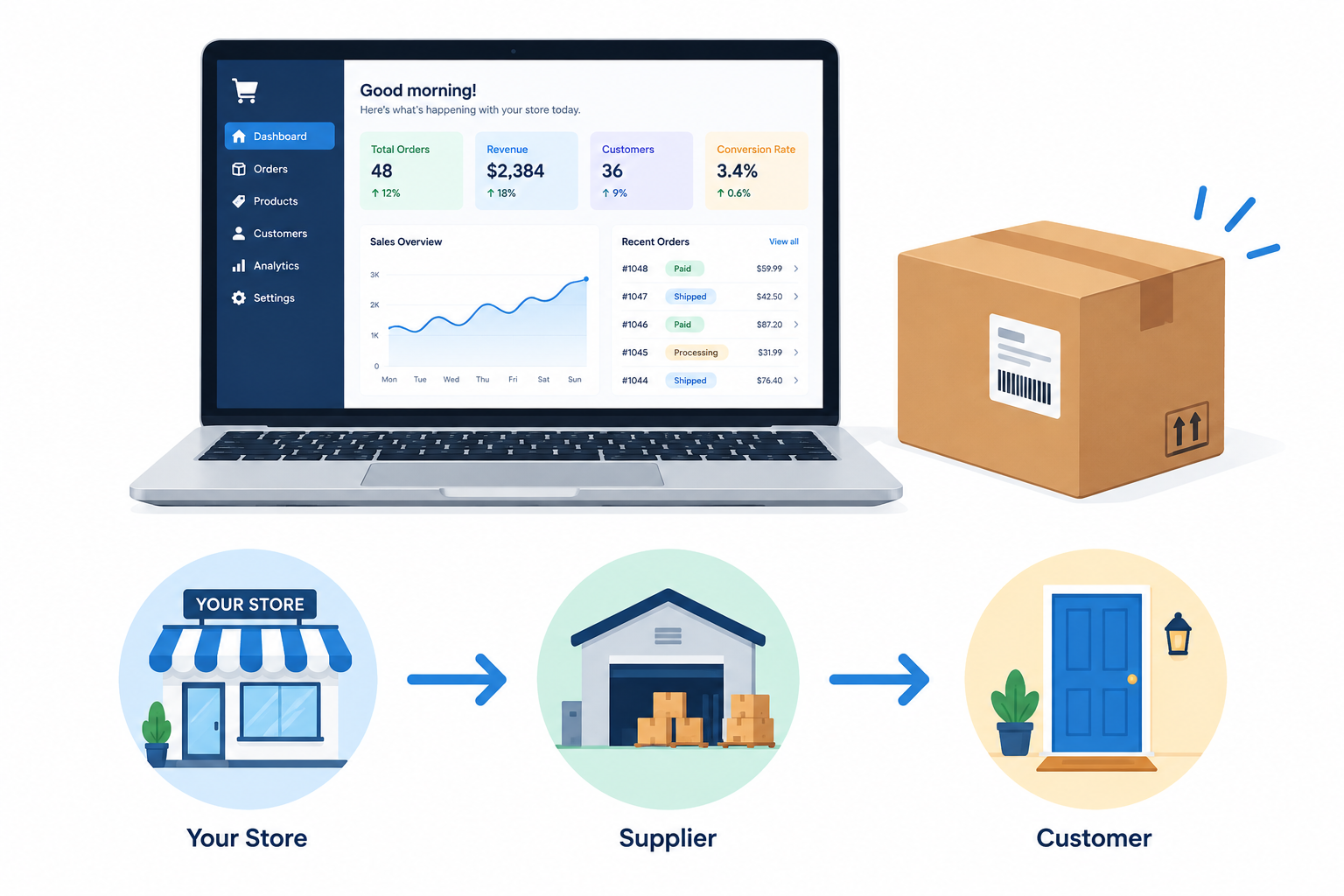
You can start dropshipping in a weekend with a store, a supplier app and a few products. Building one that makes a profit takes longer. This guide covers each step in order, with real platform costs, supplier options and the 2025 rule changes that still affect beginners in late 2026.
Last updated: October 29, 2026
What dropshipping is
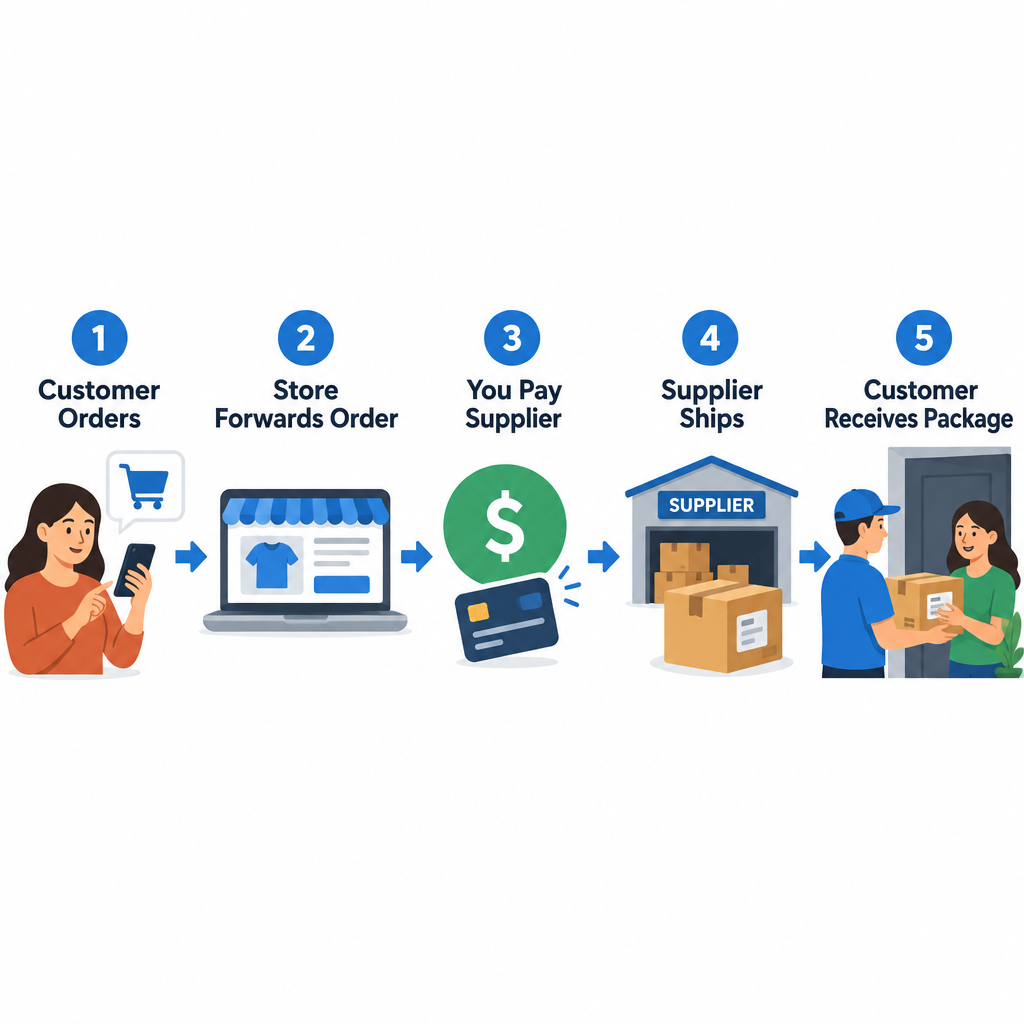
Dropshipping is a retail model where you never hold stock. A customer buys from your store, you pass the order to a supplier, and the supplier ships the product directly to the customer. You earn the difference between your price and the supplier’s price, minus fees and marketing.
If you’re new to how ecommerce works, here is the order flow in plain terms:
- A shopper finds your product through an ad, search result or social post.
- They pay you the full retail price at checkout.
- Your store sends the order to the supplier, usually automatically through an app that syncs orders.
- You pay the supplier the wholesale price plus shipping.
- The supplier packs and ships the parcel, then sends a tracking number back to your store.
- Your store emails the tracking number to the customer.
You own the brand, the website, the marketing and the customer relationship. The supplier owns the inventory, the warehouse and the packing line. That split shapes everything else in this guide.
Is dropshipping worth it in 2026?
Yes, for the right person with realistic expectations. You should treat dropshipping as a marketing business with outsourced fulfilment, not as passive income. The “set it and forget it” pitch you see in ads is the main reason most beginners quit within a few months.
Here is what works in its favour:
- Low upfront cost. You don’t buy inventory, so your cash isn’t tied up in boxes in a spare room.
- Fast testing. You can list a product today and pull it tomorrow if it doesn’t sell.
- Location freedom. You can run the whole thing from a laptop.
And here is what works against it:
- Thin margins. You pay more per unit than a brand that buys in bulk.
- Less control. Shipping speed, packaging and product quality sit with someone else.
- Heavy competition. Anyone can import the same AliExpress product you found.
- Customer service load. When a parcel is late, the customer emails you, not the supplier.
The landscape also changed in 2025. The United States suspended its $800 “de minimis” duty exemption for China and Hong Kong on May 2, 2025, then for all countries on August 29, 2025. Before that, a large share of cheap dropshipped parcels entered the US duty-free. Now low-value shipments face duties, and tariff rates on Chinese goods have shifted several times. If you plan to sell to US customers from overseas suppliers, factor duties into every price and check current rates before you launch.
The upside is that the opportunity hasn’t gone anywhere. Shopify alone reported $292.3 billion in gross merchandise volume for 2024, and a meaningful share of that comes from small stores. The stores that survive tend to pick a niche, use faster suppliers and build an actual brand.
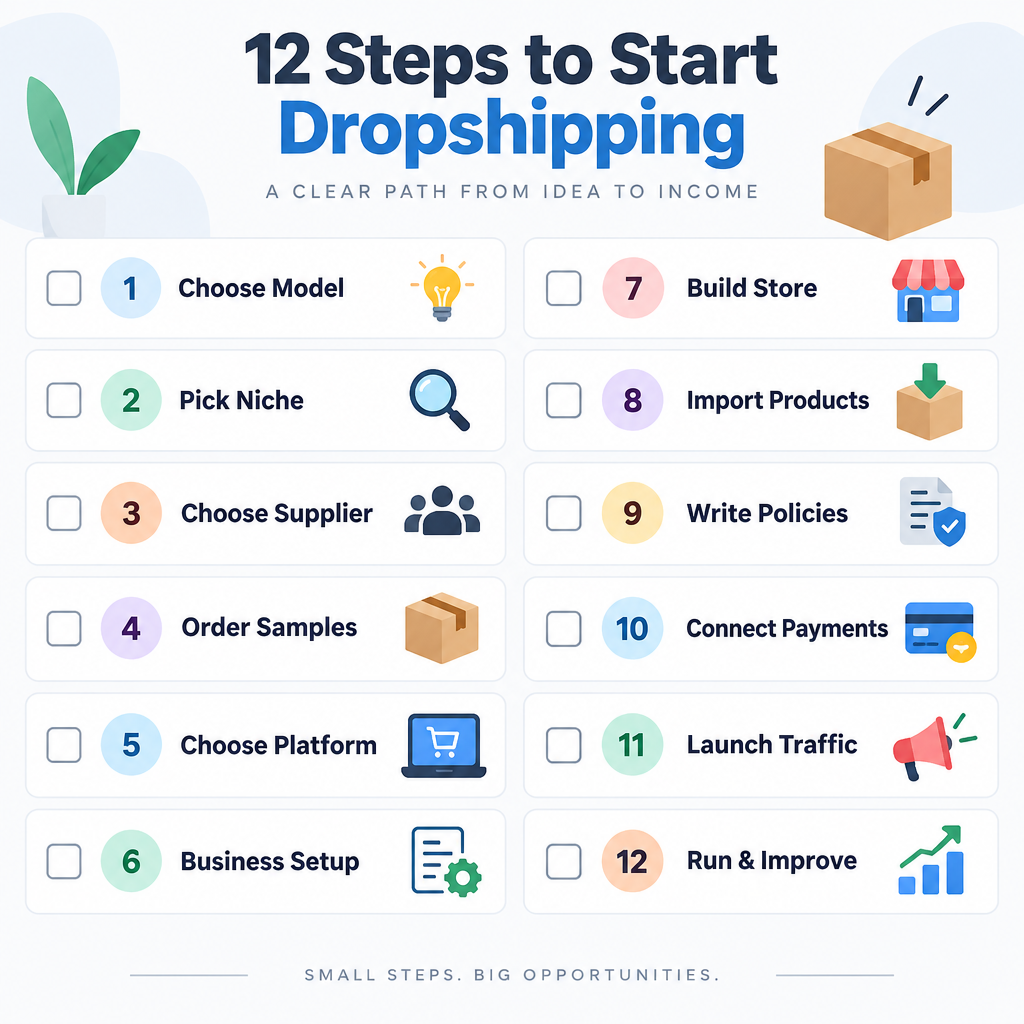
The 12 steps at a glance
Use this table as your checklist. Times assume you work on it part-time.
| Step | What you do | Typical time | Typical cost |
|---|---|---|---|
| 1 | Choose your model and budget | 1 day | $0 |
| 2 | Pick a niche with real demand | 2-4 days | $0 |
| 3 | Choose a supplier | 1-3 days | $0-$40/month for apps |
| 4 | Order samples | 1-3 weeks (waiting) | $30-$150 |
| 5 | Choose your store platform | 1 day | $0-$39/month to start |
| 6 | Set up the business and tax basics | 1-7 days | $0-$500 depending on entity |
| 7 | Register a domain and build the store | 2-5 days | $10-$20/year for a .com |
| 8 | Import products and set prices | 1-3 days | $0 |
| 9 | Write shipping, returns and policy pages | 1 day | $0 |
| 10 | Connect payments and order sync | Half a day | Per-transaction fees |
| 11 | Launch and drive traffic | Ongoing | $0 for organic, $300+ to test ads |
| 12 | Run and improve operations | Ongoing | Time |
How to start dropshipping: 12 steps for beginners
1. Choose your dropshipping model and budget
Before you look at a single product, define what kind of store you’re building. There are three common models, and each one changes your supplier, your platform and your marketing strategy.
| Model | How it works | Best for | Main drawback |
|---|---|---|---|
| General store | Sells unrelated trending products | Quick product testing | Hard to build trust or repeat customers |
| Niche store | One focused category, such as pet grooming or home espresso | Most beginners | Needs more research upfront |
| Print-on-demand (POD) | Your designs printed on shirts, mugs, posters when ordered | Creators and designers | Lower margins on basics, design work needed |
Our recommendation for most beginners is a niche store. It gives you a clear audience to serve, makes content and ads easier to write, and lets you sell multiple related products to the same customer.
Next, set a budget. A lean launch with organic marketing can run under $200 for the first month. If you want to test paid ads properly, plan for $500 to $1,500 so you can run several product tests before you judge the results. Never spend money you can’t afford to lose on ads.
2. Pick a niche with real demand
A good niche has buyers who spend money regularly, products that are hard to find in local stores and enough room to stand out. Passion helps, but demand matters more.
Use these free checks before you commit:
- Google Trends. Look at five years of data. You want steady or rising interest, not a single spike.
- Amazon and Etsy reviews. Read the three-star reviews on top sellers. Complaints point to gaps you can fill with better products or clearer listings.
- TikTok and Instagram search. If people post about the problem your product solves, you can reach them with content.
- Reddit communities. Hobby subreddits show what enthusiasts buy, what they hate and how much they spend.
Then score the products you shortlist. Look for a retail price between roughly $25 and $80, which leaves enough room for ad costs. Favour light, non-fragile items that are cheap to ship. Avoid anything with sizing headaches, safety certification requirements or trademark issues.
Builder tip
Skip products with a famous brand name, character or logo on them. Payment processors and ad platforms will shut you down fast, and you risk a trademark claim.
3. Choose a dropshipping supplier
Your supplier is your warehouse, your packing team and half your customer experience. Pick carefully.
Selection criteria for suppliers
Judge every supplier against these points:
- Shipping speed to your main market. Budget routes from China commonly take one to three weeks. Suppliers with US or EU warehouses often deliver in under a week.
- Duties handling. For US customers, ask whether the supplier ships with duties paid (often called DDP). Otherwise your customer may get a surprise bill on delivery.
- Order and inventory sync. The supplier should connect to your store so stock levels, orders and tracking numbers update automatically.
- Product quality. Check reviews, ratings and order history, then confirm with samples.
- Branding options. Custom packing slips, inserts or plain packaging help you look like a real brand.
- Returns and defects policy. Know who pays when an item arrives broken.
- Communication. Send a pre-sales question and see how fast and clearly they answer.
Popular supplier apps compared
| Supplier or app | Product source | Works with | Cost model |
|---|---|---|---|
| DSers | AliExpress (official dropshipping partner) | Shopify, WooCommerce, Wix | Free plan, paid tiers for more features |
| CJdropshipping | Own sourcing plus warehouses in several countries including the US | Shopify, WooCommerce and others | Free to use, you pay product and shipping |
| Spocket | Mainly US and EU suppliers | Shopify, WooCommerce, Wix and others | Subscription with trial |
| Syncee | Global supplier marketplace | Shopify, WooCommerce, Wix, Squarespace, BigCommerce | Subscription tiers |
| Printful | Print-on-demand with its own fulfilment centres | Shopify, WooCommerce, Etsy, Squarespace and more | No monthly fee, pay per order |
| Printify | Print-on-demand through a network of print providers | Shopify, WooCommerce, Etsy and more | Free plan, optional Premium subscription |
A word on Oberlo: if an older guide tells you to install it, that guide is out of date. Shopify shut Oberlo down in 2022, and DSers became the usual replacement for AliExpress orders.
Avoid paying for “supplier lists” sold by course sellers or influencers. The legitimate directories above, plus direct contact with wholesalers, cover everything a beginner needs.
4. Order samples before you sell
Order every product you plan to list. Yes, every one. Samples show you the real quality, the packaging, the actual shipping time to your door and whether the photos match reality.
Track each sample in a simple spreadsheet. Record the order date, delivery date, condition on arrival and your quality rating out of five. This becomes your evidence when you choose between two suppliers for the same item.
Samples also give you original photos and videos. Your own footage of the product in use performs far better in ads than the supplier’s stock images that hundreds of other stores already use.
5. Choose your store platform
You have two broad options: your own website or a marketplace like Etsy, eBay or Amazon. For most dropshippers, your own store is the right base, because you control the brand, the customer data and the margins.
Platform comparison
| Platform | Starting cost | Dropshipping app support | Hosting | Best for |
|---|---|---|---|---|
| Shopify | Basic $39/month billed monthly, $29/month billed yearly | Largest app ecosystem | Included | Most beginners |
| WooCommerce | Free plugin, plus hosting (often $10-$40/month for decent managed hosting) | Strong (DSers, CJ, Spocket, AutoDS and more) | You arrange it | Owners comfortable with WordPress |
| Wix | Paid ecommerce plan required (price varies by region) | Good (Modalyst, which Wix owns, plus Spocket and others) | Included | Design-led small stores |
| Squarespace | Commerce-capable plan required | Limited, Printful and a few others | Included | POD and creator brands |
Shopify prices above are its US list prices as we last confirmed them. Shopify adjusts plans and trial offers by region, so check the pricing page before you subscribe. Its higher plans, Grow at $105/month and Advanced at $399/month on monthly billing, only make sense once you have steady sales.
Our top pick for beginners is Shopify Basic with one supplier app. The Shopify ecommerce platform handles hosting, security, checkout and payment processing in one place, and nearly every dropshipping supplier builds for it first. You spend your time on products and marketing instead of server updates.
WooCommerce is the better choice if you already run a WordPress site or want full control. Expect more setup work. WordPress currently recommends PHP 8.3 or newer, MySQL 8.0 or MariaDB 10.6 or newer, and HTTPS support, so pick a host that meets those requirements and keeps them current.
Security note
Never install “nulled” or pirated premium themes and plugins on a WooCommerce store. They frequently contain backdoors that steal customer and payment data. Buy from the developer or use free versions from the official directory.
Selling on marketplaces
Marketplaces bring built-in traffic but strict dropshipping rules. Break them and you lose the account.
| Marketplace | Dropshipping allowed? | Key rule |
|---|---|---|
| Amazon | Yes, with conditions | You must be the seller of record, identify yourself on packing slips and invoices, and handle returns. Buying from another online retailer and having them ship to your customer is not allowed. |
| eBay | Yes, with conditions | You can use wholesale suppliers, but you can’t list an item and then buy it from another retailer or marketplace to ship to the buyer. You’re responsible for delivery on time. |
| Etsy | Only in limited forms | Etsy is for handmade, vintage and craft supplies. Print-on-demand of your own designs is allowed if you disclose your production partner. Reselling generic products is not. |
Etsy also charges a $0.20 listing fee and a 6.5% transaction fee, plus payment processing (3% + $0.25 in the US), so your pricing needs to absorb those costs.
6. Set up your business and tax basics
Learning how to start a dropshipping company properly means handling the paperwork early. It costs less to do it before your first sale than to untangle it later. This section covers the US and EU basics. Speak to a local accountant for your exact situation, because rules differ by country and state.
Business structure. In the US, many people start as a sole proprietor and form an LLC once sales are steady. An LLC separates your personal assets from business debts. State filing fees vary widely.
Stripe Atlas for non-US founders. If you live outside the US but want a US company and bank account, Stripe Atlas forms a Delaware LLC or C corporation for a one-time $500 fee and helps you get an EIN and open a US bank account. It suits founders who want to sell into the US with Stripe or Shopify Payments. US residents can usually form an LLC directly with their state for less.
Sales tax in the US. Since the 2018 South Dakota v. Wayfair decision, states can require you to collect sales tax once you pass an “economic nexus” threshold, commonly $100,000 in annual sales into that state, with higher thresholds in a few large states such as California, Texas and New York. Shopify and WooCommerce tax tools can calculate tax, but you still need to register and file.
Resale certificates. Your supplier may charge you sales tax on wholesale orders unless you give them a resale certificate. Ask about this early, because paying tax twice eats your margin.
Selling into the EU and UK. The EU removed its €22 low-value VAT exemption in July 2021. The Import One-Stop Shop (IOSS) lets you collect VAT at checkout on consignments up to €150. The UK requires sellers to collect VAT at the point of sale on goods up to £135. The EU’s General Product Safety Regulation, in force since December 13, 2024, also requires an EU-based responsible person for many products sold to EU consumers. Ask your supplier who fills that role before you sell there.
Separate finances. Open a business bank account and a dedicated card for supplier payments and ads. Clean records make taxes, refunds and chargeback disputes far easier.
7. Register a domain and build your store
Pick a brand name that’s short, easy to spell and not tied to a single product. “Northpaw Supply” can grow into new pet products; “Best Dog Brush Store” can’t.
You’ll need to register for a domain name, usually $10 to $20 a year for a .com. Buying it through your platform is simplest. Buying it from a separate registrar gives you more control, but you’ll then point it at your store through the domain name system, which means updating DNS records such as an A record and a CNAME. Changes usually work within an hour but can take up to 48 hours to spread everywhere.
Shopify store setup steps
- Sign up for Shopify and choose the Basic plan.
- Go to Settings > Domains and connect or buy your domain.
- Go to Online Store > Themes and pick a free theme such as Dawn.
- Add your logo, brand colours and fonts in the theme editor.
- Create your homepage, About, Contact and FAQ pages.
- Set up navigation menus under Content > Menus.
- Remove the storefront password only when products and policies are ready.
Shopify and Wix both offer an AI website builder feature that drafts layouts, product descriptions and page copy from a prompt. It’s a useful starting point. Edit everything it writes, because generic AI text reads like every other dropshipping store and does nothing for trust.
Keep the design simple. Fast load times, clear product photos, visible shipping times and trust signals (contact details, real policies, reviews) matter more than animations.
8. Import products and set your prices
Once your supplier app is connected, importing a product takes a few clicks. The real work is rewriting the listing so it sells.
For every product page:
- Rewrite the title in plain language. Drop the keyword-stuffed supplier title.
- Write a description that leads with the problem it solves, then lists specs (size, materials, weight).
- Replace or supplement supplier images with your own sample photos and video.
- State the delivery window clearly near the buy button.
- Add sizing charts or compatibility notes where relevant.
How to price for profit
Beginners usually price too low. Work out every cost per order, then set a price that leaves real profit after advertising. Here’s an example for a product with a $9 supplier cost:
| Line item | Amount |
|---|---|
| Retail price | $34.99 |
| Supplier product cost | -$9.00 |
| Shipping from supplier | -$4.50 |
| Duties allowance (US, varies by product and origin) | -$2.00 |
| Payment processing (2.9% + $0.30) | -$1.31 |
| Ad cost to win one sale (example) | -$12.00 |
| Profit per order | $6.18 |
The 2.9% + 30¢ rate matches Shopify Payments on the Basic plan for US online cards and Stripe’s standard US rate. If you use a third-party gateway on Shopify instead of Shopify Payments, Shopify adds its own transaction fee on top (2% on Basic), so most beginners should stick with Shopify Payments where it’s available.
Notice how the ad cost dominates. If your cost to win a sale climbs to $20, this product loses money. That’s why many sellers aim to price at three times their landed cost or higher, and why bundles and higher-priced items often work better than $15 impulse buys.
Builder tip
Use a free shipping threshold, such as free shipping over $49, to raise average order value. It often adds more profit than lowering prices.
9. Write your shipping, returns and policy pages
Clear policies prevent most customer complaints and chargebacks. You need at least these pages:
- Shipping policy: processing time, delivery estimates by region, tracking, and what happens with lost parcels.
- Refund and returns policy: time window, condition of returns, who pays return shipping, and where items go back to.
- Privacy policy: what data you collect and why. Shopify has a policy generator you can start from.
- Terms of service.
- Contact page: a real email address and, ideally, a business address.
Make sure your returns policy matches your supplier’s. If your supplier only accepts defective items back to a warehouse in Shenzhen, don’t promise free returns within 60 days. Many dropshippers simply refund low-cost items without asking for the return, since return postage would cost more than the product.
In the US, the FTC’s Mail, Internet, or Telephone Order Merchandise Rule requires you to ship within the time you advertise. If you state no time, you must ship within 30 days. If you can’t meet the deadline, you have to tell the customer and offer them the option to cancel for a full refund. Slow suppliers put you on the wrong side of this rule quickly.
10. Connect payments and order sync
Set up your payment provider first, then test your full order flow end to end.
Payment and order sync setup
- In Shopify, go to Settings > Payments and activate Shopify Payments.
- Add PayPal as a second option, since many shoppers prefer it.
- Turn on Shop Pay and other express checkouts your audience uses.
- Install your supplier app and connect your supplier account.
- Map each product’s variants to the correct supplier variants.
- Turn on automatic tracking number sync to your store.
- Place a real test order and refund it once it processes.
Variant mapping is where beginners lose money. If “Blue, Large” on your store points at “Blue, Small” at the supplier, every order for that variant ships wrong. Check each mapping by hand.
Decide whether orders go to the supplier automatically or wait for your approval. Manual approval lets you catch fraud and address errors at the start. Switch to automatic once you trust the setup and have fraud filters in place.
11. Launch and get traffic
A store with no traffic makes no sales. You have two broad routes: organic (slower, cheap) and paid (faster, costs money). Most successful stores use both.
Organic traffic
- Short-form video. TikTok, Instagram Reels and YouTube Shorts reward product demos, before-and-after clips and honest reviews. Post consistently, at least several times a week.
- SEO. Write helpful buying guides and comparison posts for your niche. Optimise product titles and descriptions for the terms people actually search.
- Search consoles. Submit your sitemap to Google Search Console and Bing Webmaster Tools so both search engines find your pages quickly. Shopify generates the sitemap for you at yourdomain.com/sitemap.xml.
- Communities. Answer questions in niche forums and groups. Don’t spam links; be the person who knows the product category.
- Pinterest. It works well for home, fashion, beauty and gift niches.
Paid traffic
Meta (Facebook and Instagram) and TikTok ads are the usual starting points. Google Shopping ads work well when people already search for your product by name.
Run tests in a structured way. Give each product a fixed test budget, try two or three creatives, and judge on cost per purchase, not likes or clicks. If a product can’t reach a profitable cost per sale after a fair test, cut it and move on.
Email from day one
Install an email tool and add a signup offer to your store. Set up three automated flows before launch: a welcome series, an abandoned cart reminder and a post-purchase follow-up. Email costs almost nothing per send and often becomes your most profitable channel.
12. Run your operations and improve
After launch, your job shifts from building to operating. This is where a dropshipping business either becomes sustainable or quietly fizzles.
Customer support. Answer emails within 24 hours. Most messages ask “where is my order?”, so send proactive shipping updates to cut that volume. Saved replies help.
Track the numbers weekly:
- Conversion rate (orders divided by sessions)
- Average order value
- Cost per purchase from ads
- Refund and chargeback rate
- Average delivery time per supplier
Watch your suppliers. Delivery times drift, stock runs out and quality slips. Keep a backup supplier for your best sellers so one warehouse problem doesn’t shut your store down.
Scale what works. When a product is profitable, increase ad spend gradually, add bundles and related items, and test a higher-quality version. Some sellers eventually move best sellers to private-label stock in a third-party warehouse to cut costs and speed up shipping.
Security note
Turn on two-factor authentication for your store, supplier, email and ad accounts. Hijacked ad accounts and stolen store logins are common, and recovery takes weeks.
Always back up your store data before major theme changes, app removals or a platform migration. On Shopify, export your products, customers and orders as CSV files. On WooCommerce, take a full database and file backup before any plugin or core update.
How to start dropshipping for free
You can start with very little cash, but “free” usually means free to set up, not free to grow. Here are the realistic zero- and low-cost routes.
Print-on-demand on Etsy or a free POD account. Printful and Printify let you create products with no monthly fee. You pay only when an order comes in, and the customer has already paid you. Etsy listings cost $0.20 each, so a handful of designs costs a few dollars.
WooCommerce on existing hosting. If you already pay for WordPress hosting, WooCommerce itself is free. You add free supplier plugins and pay per order.
Shopify’s trial period. Shopify usually runs a short free trial followed by a discounted introductory period. Terms change and vary by region, so check before you sign up and set a reminder before billing starts.
Organic marketing only. Skip paid ads and build traffic through short-form video, SEO content and communities. It’s slow, often months before steady sales, but it costs time rather than money.
The catch: free routes often mean slower growth, fewer automation features and more manual work. Most people who start for free move to a paid plan once orders arrive, which is the right order of operations.
Common mistakes to avoid when starting with dropshipping
- Skipping samples. Selling something you’ve never held leads to refunds, angry reviews and payment holds.
- Hiding shipping times. Customers forgive a two-week delivery they were told about. They don’t forgive one they weren’t.
- Ignoring duties. Since the US de minimis suspension, unpaid duties can trigger refused parcels and chargebacks.
- Underpricing. If your margin can’t cover ad costs, you’re paying to stay busy.
- Selling trademarked or restricted items. This gets stores, ad accounts and payment processors shut down.
- Running a general store with no identity. It’s harder to build trust, repeat sales and email lists.
- Copying supplier listings word for word. Duplicate text and stock photos make you look like every other store selling the same thing.
- Quitting after one product test. Most products fail. Testing several is the process, not a sign you’ve failed.
- Buying expensive courses before your first sale. Spend that money on samples and ad tests instead.
- Mixing personal and business money. It makes taxes, refunds and disputes a mess.
Best practices for succeeding in your dropshipping business
- Prioritise fast suppliers. Local warehouses cost more per unit but cut refunds and support tickets, and they let you advertise realistic delivery promises.
- Build a brand, not a product page. A real name, logo, consistent tone and an About page with a human story increase trust and repeat buying.
- Own your audience. Ad platforms change rules overnight. Your email and SMS lists stay yours.
- Create original content. Your own photos, videos and guides set you apart from stores that share the same supplier.
- Respond to every review. Thank happy customers and fix problems publicly and politely.
- Keep a backup supplier for top sellers. Supply problems happen at the worst possible time.
- Check margins monthly. Supplier prices, shipping rates, duties and ad costs all shift. Reprice when they do.
- Keep apps lean. Each extra Shopify app adds monthly cost and can slow your store. Remove anything you don’t use.
Key takeaways
- Learning how to be a dropshipper means learning marketing, customer service and supplier management. It isn’t passive income.
- A niche store with fast, reliable suppliers is the best starting model for most beginners.
- Shopify Basic plus one supplier app is our top pick for a first store, with WooCommerce the strong choice for WordPress users.
- Budget for duties on US orders from overseas suppliers since the 2025 de minimis suspension.
- Order samples, price for real profit after ad costs, and publish clear shipping and returns policies before launch.
- Test several products with a fixed budget, then scale only what proves profitable.
FAQ
How do I start a dropshipping business with no experience?
Follow the steps in order: pick a niche, choose a supplier, order samples, build a simple store on Shopify or WooCommerce, write clear policies, then start marketing. Begin with five to ten products rather than hundreds. You learn faster by running a small store well than a big one badly.
How much money do you need to start dropshipping?
You can launch for under $200 using a platform trial, a domain and a few samples, with organic marketing. If you plan to run paid ads, budget $500 to $1,500 so you can test several products properly before deciding what works.
Is dropshipping legal?
Yes. Dropshipping is a legal and common retail model. You still have to follow consumer protection rules, collect sales tax or VAT where required, avoid trademarked products and follow each marketplace’s dropshipping policy.
How long does it take to make money dropshipping?
Some stores get their first sale within days of launching ads. Reaching consistent profit usually takes several months of testing products, improving listings and refining ads. Organic-only stores generally take longer to build traffic.
Can I dropship on Amazon, eBay or Etsy?
Amazon and eBay allow dropshipping if you follow their rules, which include being the seller of record and not buying from other retailers to fulfil orders. Etsy only permits it in limited forms, mainly print-on-demand of your own designs with a disclosed production partner.
Do I need a business license or LLC to start?
Many places let you start as a sole proprietor, but you may still need a local business license and sales tax registration. An LLC is optional at first in the US but worth forming once sales are steady, because it separates personal and business liability. Check your state or country’s requirements with an accountant.
What is the best platform for dropshipping beginners?
Shopify is the best fit for most beginners because it includes hosting, checkout and the widest range of supplier apps. WooCommerce suits people who already know WordPress and want more control. Wix and Squarespace work for smaller, design-focused or print-on-demand stores.