Contentful’s free plan allows 100,000 records. The cheapest paid plan costs $300 a month, and there is no tier in between. That gap, plus the Salesforce takeover that closed on September 1, 2026, is what most teams want explained before they commit. This guide covers how Contentful works, what it costs as of November 2026, which limits affect your architecture, and how it compares with Sanity, Strapi, Storyblok and headless WordPress.
In short
- Contentful is an API-first SaaS headless CMS. It stores structured content and serves it to any frontend through REST and GraphQL APIs.
- The Free plan stops at 25 content types, 100,000 records and 100K API calls a month. Lite costs $300 a month, and Enterprise is quote-only.
- Salesforce completed its acquisition on September 1, 2026. Agentforce integration has been announced, but no GA feature has shipped.
- Cache misses on the Content Delivery API are limited to 55 requests per second, so caching and static builds matter.
- Small brochure sites and teams with no developer usually do better with Storyblok, Prismic or WordPress.
Fact-checked
We checked these key facts against the sources named, on November 24, 2026:
- The company was founded in Berlin in 2013 by Sascha Konietzke and Paolo Negri (source: en.wikipedia.org)
- Traffic spikes then never reach the 55 req/s cache-miss limit or eat into your monthly API calls (source: contentful.com)
- As of November 2026, Free costs $0, Lite costs $300 a month, and an extra Lite space adds $850 a month (source: costbench.com)
- WordPress has shipped a built-in REST API since version 4.7, and the WPGraphQL plugin adds a GraphQL endpoint (source: developer.wordpress.org)
- That gap, plus the Salesforce takeover that closed on September 1, 2026, is what most teams want explained before they commit (source: dotfusion.com)
Contentful in 60 seconds
Contentful is a hosted content platform with no built-in website. Editors create structured entries, and developers pull those entries into a site, an app or an AI agent through APIs. Since September 1, 2026, it has been owned by Salesforce.
| Question | Short answer (checked November 2026) |
|---|---|
| What it is | API-first SaaS headless CMS |
| Founded | 2013 in Berlin by Sascha Konietzke and Paolo Negri |
| Owner | Salesforce, deal closed September 1, 2026 |
| Price points | Free; Lite at $300/month; Premium/Enterprise by quote |
| Best for | Brands with several locales, channels or teams, and in-house developers |
| Not for | Small brochure sites, solo owners with no developer, tight budgets |
Verdict for client builds: Contentful is a safe, mature pick when you need governance, localization and a large integration ecosystem, and you have developers. If you need a cheap site that editors can lay out themselves, start somewhere else.
What is Contentful, and what does the name mean?
Contentful is a “content hub” that holds your content as structured data instead of as finished web pages. The name joins “content” and “-ful”, meaning full of content. The company started under the name Storageroom before it rebranded.
If the basic idea is new to you, our guide to what a headless CMS is and how it actually works covers the background. In short, a traditional CMS ties content to one website theme. A headless CMS takes the “head” (the presentation layer) off and serves the content through APIs.
Headless vs. traditional CMS in one diagram
Traditional CMS (e.g. classic WordPress)
  Editor > Database > Theme/templates > One website

Headless CMS (Contentful)
  Editor > Contentful (content hub + APIs) > Next.js website
                                           > iOS/Android app
                                           > Shopify Hydrogen storefront
                                           > AI agents via MCP
The trade-off is simple. You get one source of content for every channel. In return, someone has to build and host each frontend.
Is Contentful a CMS or a DXP?
It began as a pure headless CMS and now markets itself as a broader content platform. It has added a visual builder (Contentful Studio), AI features and personalization. It still does not render or host your website, so in practical terms it is a headless CMS with DXP add-ons. Gartner’s June 2, 2026 First Take on the deal was titled “Salesforce-Contentful Deal Signals Headless SaaS Is the Future for Digital Experiences,” which shows where analysts place it.
How Contentful works: spaces, environments, content types and APIs
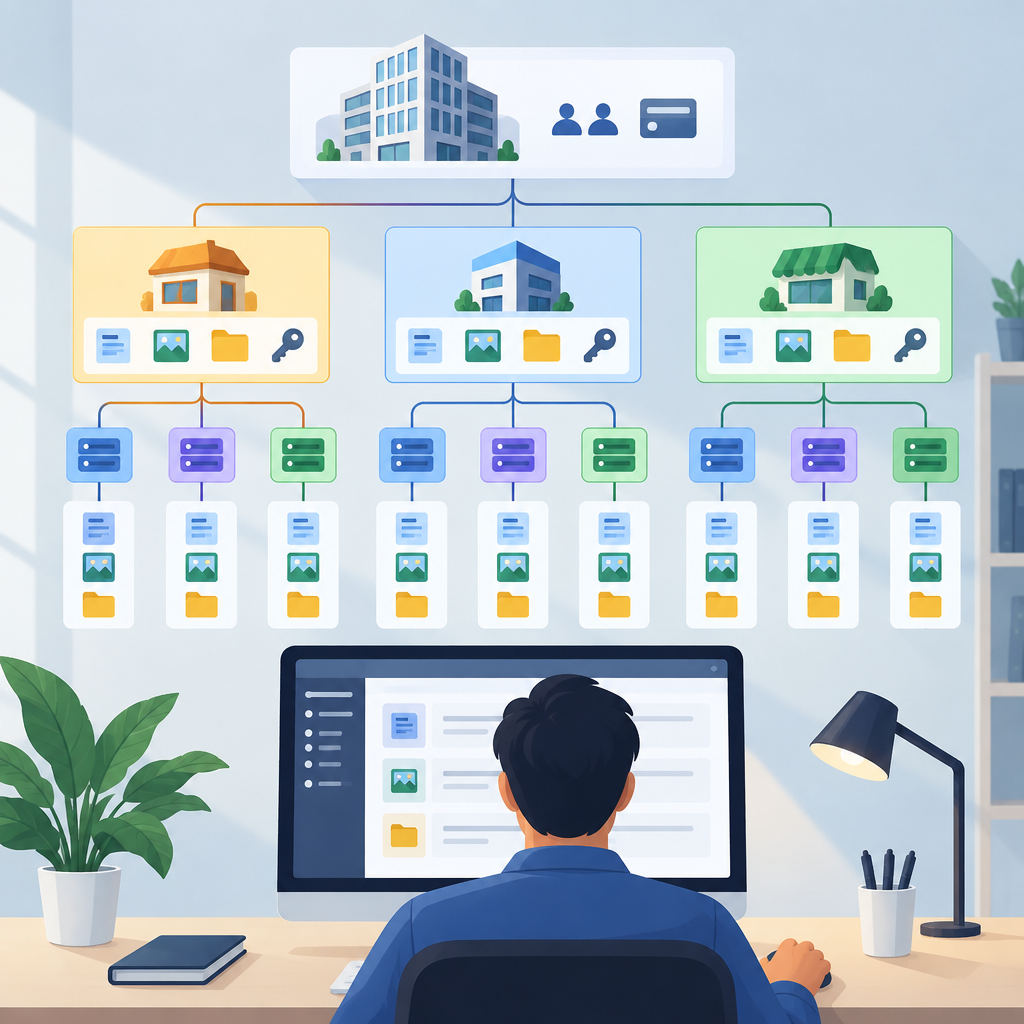
Everything in Contentful sits in a strict hierarchy. Once you understand it, pricing and limits make sense.
- Organization: your company account, where billing and users live.
- Space: a container for one project or brand. It holds content, assets and API keys.
- Environment: a copy of a space’s content model and content.
masteris production. Others are for development or testing. - Content type: a schema such as Blog Post or Product, with typed fields.
- Entry and asset: an entry is one item of a content type. An asset is an uploaded file such as an image or PDF.
- Locale: a language or region variant of each localized field.
On top of this, webhooks tell your build system when content changes. The App Framework, with apps listed in the Contentful Marketplace, lets you add custom fields, sidebars and integrations to the editor. You manage API keys under Settings > API keys and environments under Settings > Environments in each space.
Content modeling: a worked blog and product example
Model content by what it means, not by how a page looks. A marketing site with a blog and product pages might use five content types:
| Content type | Key fields | References |
|---|---|---|
| Blog Post | title, slug, excerpt, body (Rich Text), publishDate, seoTitle, seoDescription | Author, Category, Product (many) |
| Author | name, bio, photo (asset) | None |
| Category | name, slug | None |
| Product | name, sku, shopifyHandle, heroImage, features (list) | CTA |
| CTA | label, url, style | None |
References are what make this work. A Product entry can appear in a blog post, a landing page and a mobile app without being copied. If you change the price note once, every channel updates.
Builder tip
Name content types after things (Product, Author, CTA), not layouts (“Homepage Hero Left”). Meaning-based models feed web, app and AI channels without a rebuild.
Content Delivery, Preview, Management, GraphQL and Images APIs
Contentful offers five main APIs. Each one has a single job.
| API | What it does | Typical use |
|---|---|---|
| Content Delivery API (CDA) | Read-only, CDN-cached, published content | Production sites and apps |
| Content Preview API | Read-only, includes drafts | Editor previews only |
| Content Management API (CMA) | Read and write content and models | Migrations, imports, scripts |
| GraphQL Content API | Query published or preview content with GraphQL | Frontends that want exact fields in one call |
| Images API | Resize, crop and convert images by URL | Responsive images, WebP/AVIF |
Official SDKs cover JavaScript, plus other languages for the delivery and management APIs. Our explainer on GraphQL vs REST covers when each query style fits. Contentful’s GraphQL API is generated from your content model, so new fields show up in the schema automatically.
Fetching content: minimal JavaScript SDK and GraphQL snippets
With the JavaScript SDK (npm install contentful):
import { createClient } from 'contentful';

const client = createClient({
  space: process.env.CONTENTFUL_SPACE_ID,
  accessToken: process.env.CONTENTFUL_DELIVERY_TOKEN,
  // For drafts: host: 'preview.contentful.com' with a Preview token
});

const res = await client.getEntries({
  content_type: 'blogPost',
  'fields.slug': 'hello-world',
  include: 2,   // resolve Author and Product references
  limit: 1,
});

console.log(res.items[0]?.fields.title);
The same request with GraphQL:
query PostBySlug {
  blogPostCollection(where: { slug: "hello-world" }, limit: 1) {
    items {
      title
      publishDate
      author { name }
      heroImage { url(transform: { width: 1200, format: WEBP }) }
    }
  }
}
The image url points to images.ctfassets.net, which is the Images API. You can pass width and format as parameters and skip running a separate image service.
What changed in 2026: Salesforce, AI and new limits

Three things changed in 2026. Contentful changed owners, added AI tooling and tightened some API limits. The timeline below is drawn from Salesforce’s newsroom, its SEC filings and Contentful’s own newsroom and developer changelog.
| Date | Event | Why it matters |
|---|---|---|
| May 29, 2026 | Salesforce signs a definitive agreement to acquire Contentful | Strategic direction now follows Salesforce |
| June 2, 2026 | Gartner publishes its First Take on the deal | Analysts see headless SaaS as the default for DX |
| June 23, 2026 | Contentful introduces Palmata | AI discovery: shaping how AI describes your brand |
| July 2026 | Remote MCP server reaches general availability | AI agents and assistants can work with Contentful content |
| September 1, 2026 | Acquisition closes | Contentful becomes part of Salesforce |
| September 21, 2026 | SAML signing certificate cut-over | SSO setups needed the new certificate |
| October 2026 | 40,000 expanded fragment-spread limit for GraphQL | Very large GraphQL queries now fail with HTTP 400 |
The Salesforce acquisition: what it means for customers and renewals
At announcement, Salesforce said more than 4,800 brands use Contentful. It plans to make Contentful a native content layer for Agentforce and to integrate it across Customer 360.
Did you know?
Salesforce was already a Contentful shareholder before it bought the company.
As of late November 2026, here is what this means for you:
- Contracts: existing contracts stay in force until renewal. No public price changes for Free or Lite have been tied to the deal. Expect renewal talks to include Salesforce bundles, especially if you already pay for Sales Cloud, Commerce Cloud or Data Cloud.
- Agentforce: Salesforce has positioned the integration publicly but has not shipped a GA feature or date for Agentforce querying Contentful content directly. Don’t sign for a roadmap item as if it already exists.
- Data jurisdiction: CMSWire reported concerns from European public-sector and open-source voices. Now that a US company owns Contentful, it falls under US law, including the CLOUD Act. If you run a regulated EU project, check this with your legal team.
If you are mid-contract and worried, ask for multi-year price protection at renewal. Also keep your content portable. Regular exports are cheap insurance.
AI Actions, Remote MCP and Palmata
Contentful’s 2026 AI features cover three different jobs:
- AI Actions are reusable AI tasks inside the editor. Typical ones are translation, SEO metadata and image alt text, run on single entries or in bulk.
- Remote MCP is a hosted Model Context Protocol server, generally available since July 2026. It lets AI assistants and enterprise agents read and work with your Contentful content through a standard interface.
- Palmata, launched June 23, 2026, targets “AI discovery.” Its job is to give brands more say in how AI systems represent their business.
Developer changelog items you must act on
Two items from the Contentful developer changelog need attention:
- GraphQL fragment limit. A single request can now expand no more than 40,000 fragment spreads, counted after nested fragments are resolved. Queries over the limit return HTTP 400. This limit is separate from the query-complexity limit.
- SAML certificate. The SSO signing certificate cut-over took place on Monday, September 21, 2026. If SSO logins fail, check that your identity provider (Okta, Entra ID and so on) trusts the current certificate.
Contentful pricing in 2026: Free, Lite and Enterprise

Contentful has three tiers: Free, Lite at $300 a month, and quote-only Premium/Enterprise. Free plan figures below come from Contentful’s own Free plan FAQ. Lite figures come from Capterra’s pricing listing. All were checked in November 2026.
| Plan | Price | Users | Roles | Locales | API calls/month | CDN bandwidth/month | Spaces and caps |
|---|---|---|---|---|---|---|---|
| Free | $0 | 10 | 2 standard | 2 | 100K (hard cap) | 50 GB (hard cap) | 1 Starter space: 25 content types, 100,000 records, 2 environments |
| Lite | $300/month | 20 | 3 | 3 | 1M | 100 GB | One extra, larger Lite space available for $850/month |
| Premium/Enterprise | Custom quote | Custom | Custom | Custom | Unlimited | Custom | Multiple spaces, SSO, advanced governance |
Free plan limits and the hard caps
You get one Starter space with 25 content types, 100,000 records and 2 environments (including master). You also get 10 users, 2 standard roles and 2 locales. The 100K monthly API calls and 50 GB of bandwidth are hard caps, so you hit a wall instead of an overage bill. For a hobby project or a proof of concept that is fine. For a live business site, a traffic spike can stop content from loading.
Records count both entries and assets. A blog with 30,000 posts, 40,000 images and many thousands of authors and tags is already near the cap.
Builder tip
Count your content types and records against the 25 and 100,000 caps before you migrate. Large marketing sites can go over during import, once every image becomes a record.
We hit the record or content type limit on the free plan. What are our options? You have four. Merge similar content types, for example one “Page Section” type with a variant field. Delete unused assets and old drafts. Move archived content out to static files. Or upgrade to Lite. Of these, only upgrading changes the 2-environment and 2-locale caps.
Lite plan: when $300 a month makes sense
Why is there no step between the free tier and $300 a month? Contentful prices for teams with budgets, not for individuals. The jump is deliberate. Lite makes sense when you need a third locale, more than 10 editors, or traffic beyond 100K API calls. It also makes sense when a hard cap would put the business at risk. If you need several brands, the extra Lite space at $850 a month adds up quickly. At that point, get an Enterprise quote.
Enterprise: what drives the quote
Enterprise quotes depend on spaces, users, locales, bandwidth, SSO and support level, plus add-ons such as Studio or Personalization. Contentful doesn’t publish figures. Agency FocusReactive cites third-party SpendHound data that puts the average Contentful enterprise contract at about $179,000 a year, up 30% year over year. That is an outside estimate, not an official price, but it is a useful benchmark when you negotiate.
Total cost of ownership for a typical client site
The subscription is usually the smallest cost. Here is a worked example for a 3-locale marketing site on Lite. The assumptions are stated, so swap in your own rates.
| Cost line | Assumption | Year 1 |
|---|---|---|
| Contentful Lite | $300 × 12 | $3,600 |
| Frontend build | 150 developer hours × $100/hour | $15,000 |
| Frontend hosting | $40/month on a paid Vercel or Netlify tier | $480 |
| Maintenance | 5 hours/month × $100/hour | $6,000 |
| Total | $25,080 |
Year 2 drops to about $10,000 if nothing is rebuilt. A comparable WordPress site often costs less to build, because themes and page builders do the frontend work. Contentful pays off when several channels or locales reuse the same content.
Technical limits that shape your architecture
Most Contentful limits are generous. A few will break a careless build. These values come from Contentful’s technical limits documentation.
| Limit | Value | What it means for your build |
|---|---|---|
| CDA cache-miss rate limit | 55 requests/second per space (default) | Uncached server-side fetches can hit HTTP 429 during spikes |
| CDN cache hits | Not rate-limited | Caching is your main scaling tool |
| Content types per environment | 1,000 | Plenty, unless you model by layout |
| Records per space | 5,000,000 | Large catalogs fit; split by brand if needed |
| Environments per space | 151 | Room for branch-per-feature workflows on higher plans |
| Locales per organization | 500 | Enough for global brands |
| Bulk actions | 200 items | Publish big releases in batches |
| GraphQL fragment spreads | 40,000 expanded per request | Deeply nested fragment queries can fail |
Did you know?
According to Contentful’s technical limits documentation, requests served from its CDN cache don’t count toward the 55 requests per second Content Delivery API limit. Only cache misses do.
Rate limits and caching strategy
How do I avoid burning through API calls with Next.js builds and previews? Render pages statically or with incremental static regeneration. Then use Contentful webhooks to revalidate only the pages that changed. Avoid fetching from the CDA on every request in server components without a cache layer. Point preview routes at the Content Preview API with a separate token, and keep that API out of production traffic.
Builder tip
Put static generation or a CDN cache in front of the Content Delivery API. Traffic spikes then never reach the 55 req/s cache-miss limit or eat into your monthly API calls.
GraphQL complexity and the 40,000 fragment-spread limit
Contentful’s GraphQL API enforces two separate limits. One is a query-complexity allowance, driven mostly by collection limit values multiplied through nested references. The other is the newer fragment-spread cap. To stay under both, set explicit low limit values on nested collections. Split page queries into smaller ones, and don’t reuse one giant fragment for every content type. If you generate queries from component trees, log their expanded size in CI.
Contentful for editors: Studio, workflows and localization
Editors work in a form-based interface by default. That interface is clear for structured content and confusing for page layout. Studio is Contentful’s answer to that gap.
Studio and visual page assembly
Our editors find content models confusing. Is there a visual page builder? Yes. Contentful Studio includes Experiences, where developers register their own React components and marketers assemble pages visually from them.
Do I still need developers for every new landing page layout? Not with Studio. Marketers can combine existing components into new pages without a deployment. You still need developers to build new components, change design tokens and wire up data. Studio availability depends on your plan, so confirm it before you plan around it.
Localization and multi-brand governance
Localization is a real strength. Fields can be localized one by one, fallback locales fill gaps, and AI Actions can draft translations for human review. Roles, permissions, workflows and Releases let large teams stage launches. SSO via SAML is available on higher tiers. Spaces separate brands while one organization keeps billing and users central. For GDPR, Contentful acts as a processor under a data processing agreement. You still decide which personal data goes into entries.
Personalization (Ninetailed) and experimentation
Contentful Personalization came from the Ninetailed acquisition. It runs audience-based variants and A/B tests on Contentful entries. In 2026, Contentful released an open-source Optimization SDK that brings Personalization and Analytics together in one client library. That removes much of the custom wiring older guides warned about.
Pros and cons of Contentful
These pros and cons draw on Contentful’s documentation, review-site themes and the build work involved.
Pros
- Mature platform with a strong uptime record on its public status page and thorough developer docs
- Clean separation of spaces, environments and roles for governance
- Strong field-level localization, up to 500 locales per organization
- Large App Framework and Marketplace ecosystem
- REST, GraphQL and Images APIs, plus Remote MCP for AI agents
- Studio reduces developer dependence for page assembly
Cons
- Steep jump from Free to $300/month, and a much bigger jump to Enterprise
- Hard caps on the Free plan can stop a live site
- Form-based editing feels abstract to non-technical editors without Studio
- You pay separately to build and host every frontend
- Content types are configured in the web app or by migration scripts, not as code in the repository like Sanity
- Roadmap is now tied to Salesforce priorities
Contentful vs. Sanity, Strapi, Storyblok, Prismic and headless WordPress

Contentful is the governance-heavy, enterprise-leaning choice. Sanity is the developer-flexible one, Strapi is open source, Storyblok is the most visual, and headless WordPress is the cheapest when your team already knows WordPress. Prices below were checked in November 2026.
| CMS | Model | Hosting | Entry paid price | Editor experience | Best for |
|---|---|---|---|---|---|
| Contentful | SaaS, API-first | Vendor cloud | Lite $300/month | Forms, plus Studio visual builder | Multi-locale, multi-brand enterprises |
| Sanity | SaaS content lake, schemas as code | Vendor cloud | Growth about $15/user/month | Fully customizable Sanity Studio | Developer-led teams |
| Strapi | Open source (Node.js) | Self-host or Strapi Cloud | Free self-hosted; Cloud from $35/project/month | Admin panel, forms | Data control, custom backends |
| Storyblok | SaaS, component-based | Vendor cloud | Growth from $99/month | Visual editor with live preview | Marketer-led page building |
| Prismic | SaaS, slice-based | Vendor cloud | Free plan, low-cost paid tiers | Slice-based page builder | Marketing sites on Next.js or Nuxt |
| Headless WordPress | Open source (PHP) + REST or WPGraphQL | Self-host | Software free; pay for hosting | Familiar block editor | Existing WordPress teams |
| Contentstack | SaaS, enterprise | Vendor cloud | Quote only | Enterprise workflows, visual builder | Large DXP buyers |
| Amplience | SaaS, commerce-focused | Vendor cloud | Quote only | Visual, commerce-oriented | Large retailers |
Pick this if:
- Contentful: you have developers, three or more locales, and need roles and audit-friendly governance.
- Sanity: your developers want to define schemas in code and customize the editor. Contentful vs Sanity for a 5-person team: which is cheaper long term? Sanity, by a wide margin. Five Growth seats come to about $75 a month against Contentful’s $300.
- Strapi: you want to own the database and host it yourself, and you have DevOps skills.
- Storyblok: marketers build most pages and want drag-and-drop editing from day one.
- Prismic: you run a small to mid-sized marketing site on a modern framework and want low cost.
- Headless WordPress: your editors already know WordPress and you need the lowest licence cost.
Can WordPress be a headless CMS?
Yes. WordPress has shipped a built-in REST API since version 4.7, and the WPGraphQL plugin adds a GraphQL endpoint. You keep the familiar editor and plugins, and a Next.js or Astro frontend reads the content. Our guide to the Astro framework covers that frontend option. The catch is that you still run, secure and update a PHP server, and many plugins assume a WordPress theme.
Is Amplience a headless CMS?
Yes. Amplience is a headless, API-first content platform aimed at commerce brands. It pairs a content hub with image and media management and visual tools for merchandising teams. Pricing is quote-only and targets enterprise retailers.
Top 10 headless CMS platforms at a glance
- Contentful: enterprise SaaS, strongest governance
- Sanity: code-defined schemas, real-time collaboration
- Strapi: leading open-source Node.js option
- Storyblok: visual, component-based editing
- Prismic: slice-based page building for marketers
- Contentstack: enterprise DXP rival to Contentful
- Amplience: commerce-focused content platform
- Hygraph: GraphQL-native, content federation
- Directus: open-source layer over any SQL database
- Payload: open-source, TypeScript-first, runs inside Next.js
Common Contentful use cases and stacks
Contentful is most often paired with Next.js for marketing sites, Shopify Hydrogen for storefronts, and native apps that share the same content. Vercel and Netlify are the usual hosts for web frontends.
Contentful + Shopify (Hydrogen)
Shopify keeps products, checkout and inventory. Contentful holds editorial content such as lookbooks, buying guides and campaign pages. Hydrogen is Shopify’s React framework, hosted on Oxygen, and it fetches from both APIs. Store a shopifyHandle field on Contentful Product entries to join the two. Our explainer on the Shopify ecommerce platform covers the commerce side.
Contentful + Next.js
Use static or ISR pages for production and Next.js Draft Mode with the Preview API for editors. Add a webhook that triggers on-demand revalidation. This setup keeps API calls low and previews instant.
Can I migrate from WordPress to Contentful without losing SEO? Yes, if you plan the migration around URLs. Follow these steps:
Migration steps
- Back up WordPress files and database, and export Contentful if a space already exists.
- Crawl the old site and record every URL, title and meta description.
- Add slug, seoTitle, seoDescription and canonical fields to your content types.
- Import posts with the Content Management API, keeping the original slugs.
- Rebuild the same URL structure in the frontend, plus 301 redirects for any change.
- Generate an XML sitemap, submit it in Google Search Console and watch crawl errors.
Security note
Back up before any model change, migration or plan switch. Run contentful space export --space-id <ID> --environment-id master with the Contentful CLI, and test changes in a non-master environment first.
Is Contentful right for you? Decision checklist
Choose Contentful if you can answer “yes” to most of these:
- You have at least one developer to build and maintain the frontend.
- You publish in three or more locales, or across several brands or channels.
- You expect more than 100,000 records within a year or two.
- You can budget at least $300 a month, plus build and hosting costs.
- Editors can work with structured forms, or you will add Studio.
- You already run Salesforce and want content near your CRM and Agentforce.
Is Contentful worth it for a small team, or is it overkill? For a five-page brochure site with one editor and no developer, it is overkill. Pick WordPress, Squarespace or a builder. Our guide to building a Squarespace site step by step suits that case. For a small product team shipping a web app and a mobile app from one content source, Contentful’s Free or Lite plan can be the right call.
Before you sign, export your content model and sketch your first year of content against the Free and Lite caps. That one exercise will tell you whether Contentful fits your budget.
FAQ
What is Contentful headless CMS?
Contentful is a cloud-hosted, API-first content management system. It stores structured content and delivers it to websites, apps and AI tools through REST and GraphQL APIs, with no built-in frontend.
What does “Contentful” mean?
The name joins “content” and “-ful,” meaning full of content. The company was founded in Berlin in 2013 by Sascha Konietzke and Paolo Negri.
Is Contentful free?
Yes, there is a free plan. It includes one Starter space, 25 content types, 100,000 records, 2 locales, 10 users and 100K API calls a month. The API and bandwidth limits are hard caps.
How much does Contentful cost per month?
As of November 2026, Free costs $0, Lite costs $300 a month, and an extra Lite space adds $850 a month. Premium/Enterprise is quote-only.
Is Contentful owned by Salesforce?
Yes. Salesforce completed the acquisition on September 1, 2026.
What happens to our Contentful contract and pricing now that Salesforce owns it?
Existing contracts run as signed until renewal. Expect bundling offers at renewal, so negotiate price protection and keep regular content exports.
Can WordPress be a headless CMS?
Yes. WordPress core includes a REST API, and WPGraphQL adds GraphQL. A separate frontend such as Next.js or Astro then displays the content.
Is Amplience a headless CMS?
Yes. Amplience is an API-first headless content platform built mainly for commerce brands, sold on custom quotes.
What are the top 10 headless CMS platforms?
The ten covered above are Contentful, Sanity, Strapi, Storyblok, Prismic, Contentstack, Amplience, Hygraph, Directus and Payload. Headless WordPress is a common budget alternative.
Is Contentful better than Sanity or Strapi?
For governance, localization and enterprise support, Contentful is the stronger choice. Sanity costs less for small teams and gives developers more freedom. Strapi wins if you need open source and self-hosting.
Does Contentful support GraphQL?
Yes. The GraphQL Content API is generated from your content model and serves both published and preview content. It has query-complexity limits and a cap of 40,000 expanded fragment spreads per request.
About this article
- Fact-checked by Moira Hensley against the sources listed below before publication.
- Published
Sources (8)
- FAQs for the Contentful Free plan changes (contentful.com)
- Contentful Pricing 2026 | Capterra (capterra.com)
- Contentful pricing 2026: free tier limits, the $300 cliff and enterprise (dev.to)
- Contentful Pricing: Real Costs, Hidden Fees, and Smarter Alternatives (focusreactive.com)
- Salesforce Signs Definitive Agreement to Acquire Contentful (salesforce.com)
- Salesforce Buys Contentful, Adds Headless CMS For Agentforce (cmswire.com)
- Salesforce Acquired Contentful: This Is What It Means for Contentful Customers (storyblok.com)
- Upcoming Limit for Expanded GraphQL Fragment Spreads (contentful.com)